Building a Premium Hotel Website: Design, Systems and Excellence at Casa Blue Sarantis
A developer case study on Casa Blue Sarantis, exploring responsive hotel website design, reusable WordPress and Elementor components, multilingual SEO, booking-focused UX and production quality.
WEB DESIGN · WORDPRESS DEVELOPMENT · TECHNICAL SEO
A developer case study on responsive hospitality UX, reusable WordPress components, multilingual SEO and the technical thinking behind a cohesive hotel website.
Primary keyword: hotel website design
A premium hotel website is more than a collection of attractive screens. It is a connected system that helps guests understand a property, explore accommodation, find reliable information and take the next step towards booking. This Casa Blue Sarantis case study looks at the design concepts alongside the WordPress architecture and operational discipline needed to support them.
Casa Blue Sarantis is presented here as a hospitality website project for Faliraki, Rhodes. The visual direction uses Mediterranean photography, elegant typography, a navy-and-white palette and turquoise accents. The accompanying theme audit documents a classic PHP and Elementor Free architecture, 22 custom Elementor widgets, structured content types, native SEO modules, multilingual URL handling, booking-click analytics, performance controls and security safeguards. These are documented theme capabilities, not a claim that every live-site outcome has been independently measured.
Homepage Design: A Clear First Impression
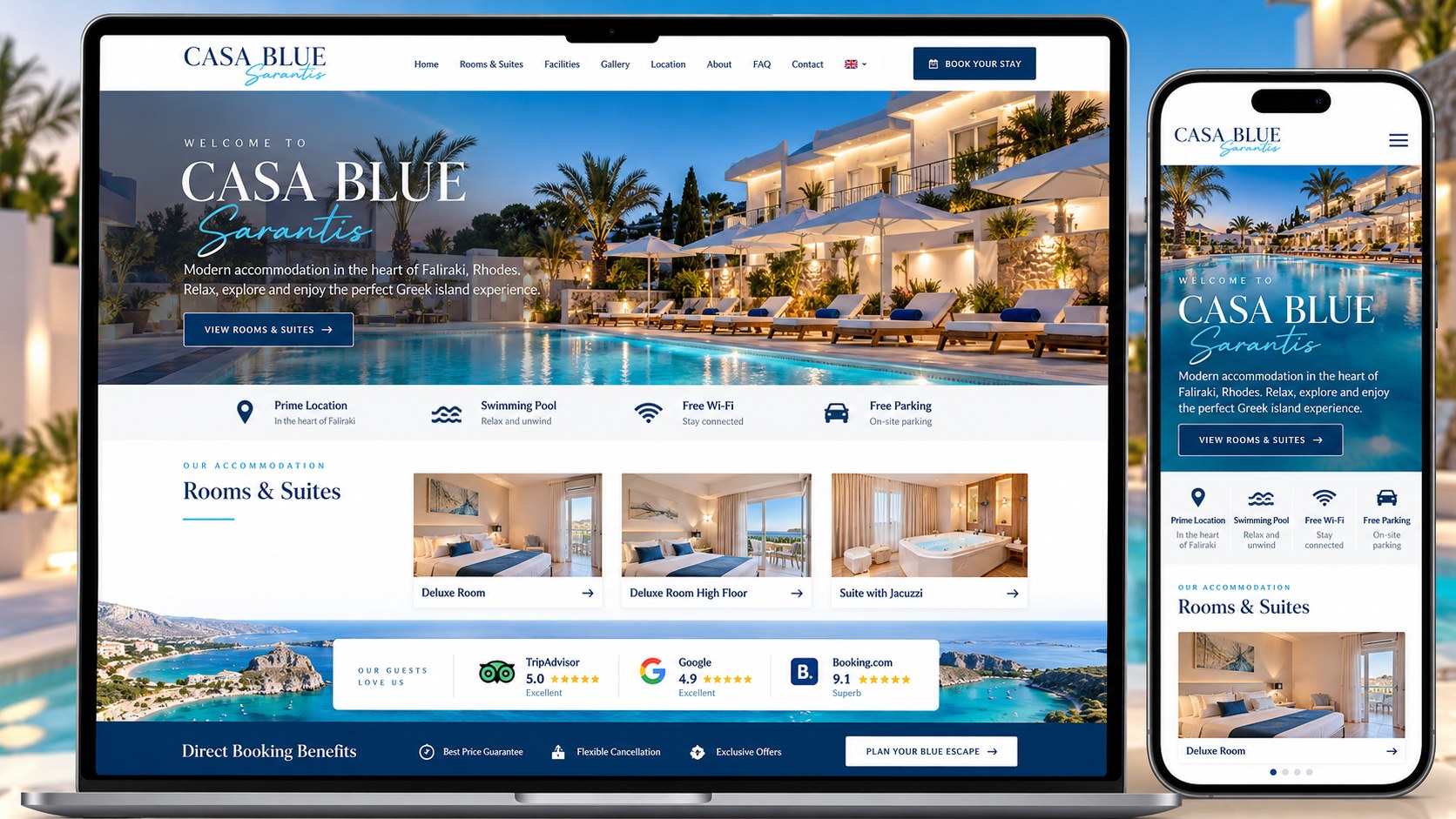
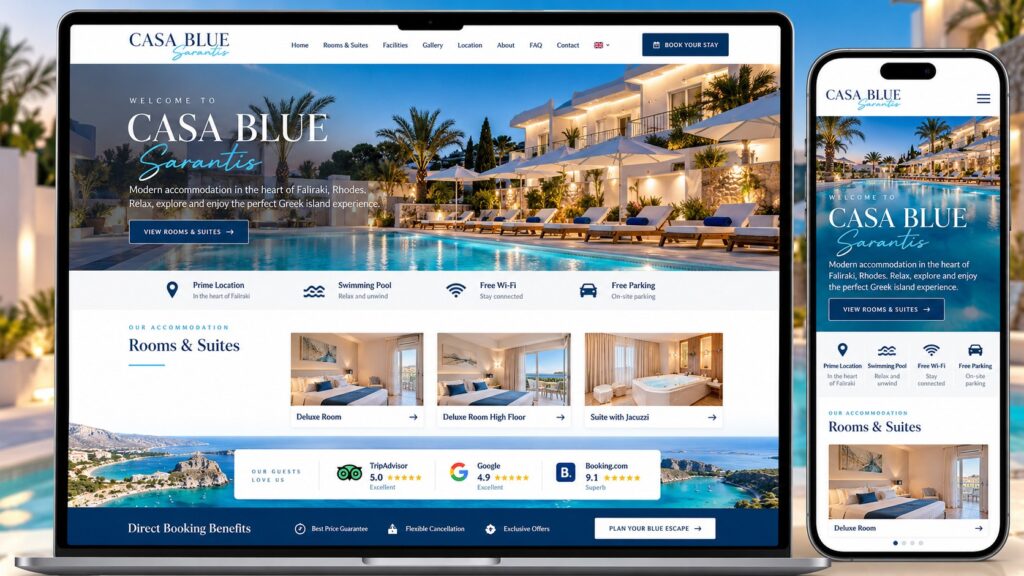
A hospitality homepage has to communicate the property, set expectations and make the next action easy. The Casa Blue Sarantis concept uses a panoramic resort hero, restrained navy-and-white styling, turquoise accents and a prominent booking action. A concise benefits strip helps visitors scan practical highlights before exploring rooms. On smaller screens, the same hierarchy becomes a compact, vertical journey. The design principle is not decoration for its own sake: every element should help guests understand the property and move confidently to the next step.
Room Detail UX: From Browsing to Booking
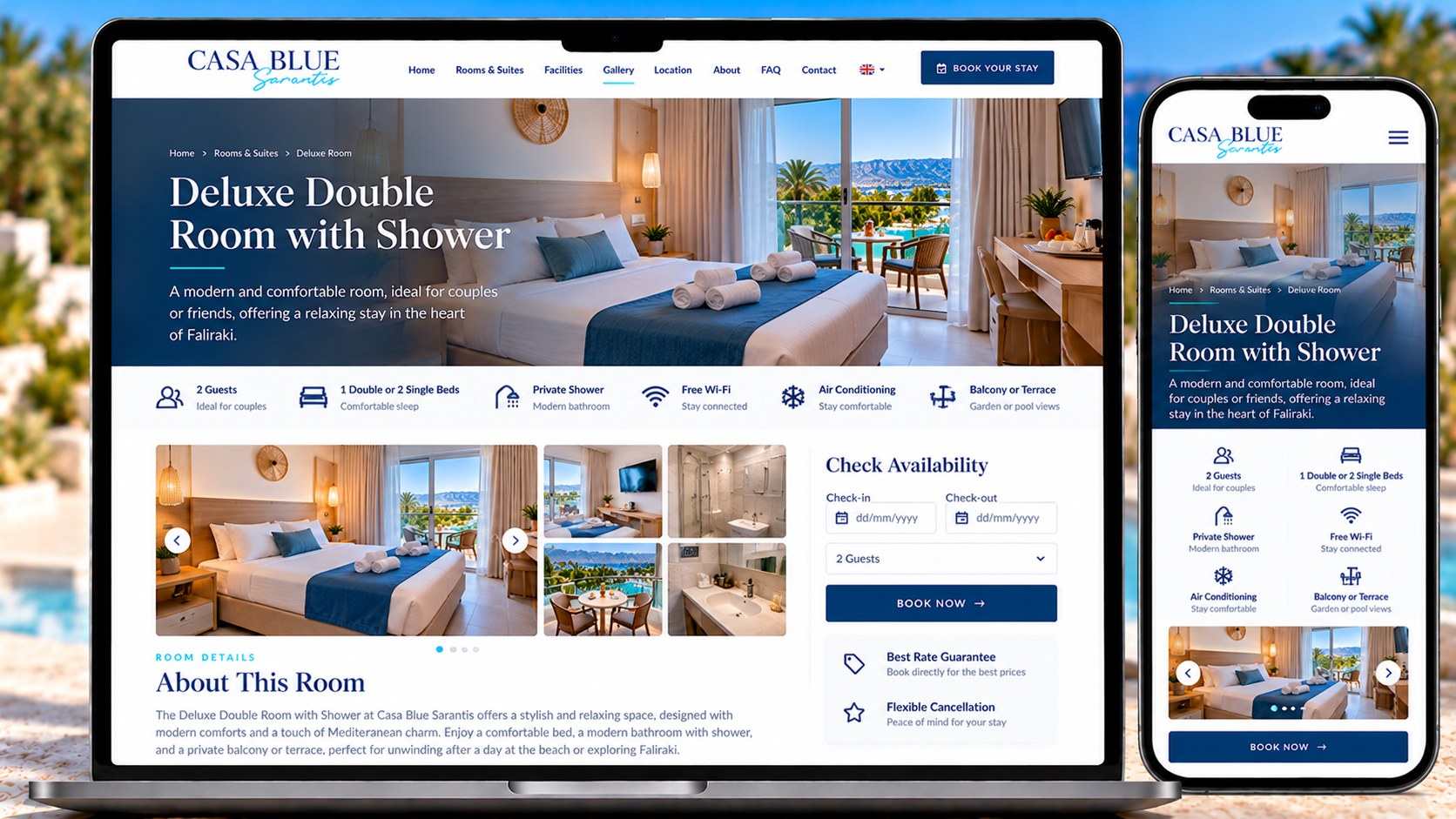
A dedicated room page should answer the questions guests ask before reserving: what the room looks like, how it is configured, which amenities are included and where to check availability. The concept combines a room gallery, concise description, amenity highlights and a booking panel. Real production content must use verified room capacity, bedding, features and booking conditions. A visual booking panel is only the interface; availability and reservation actions must connect to the actual booking system.
Facilities Page: Making Amenities Scannable
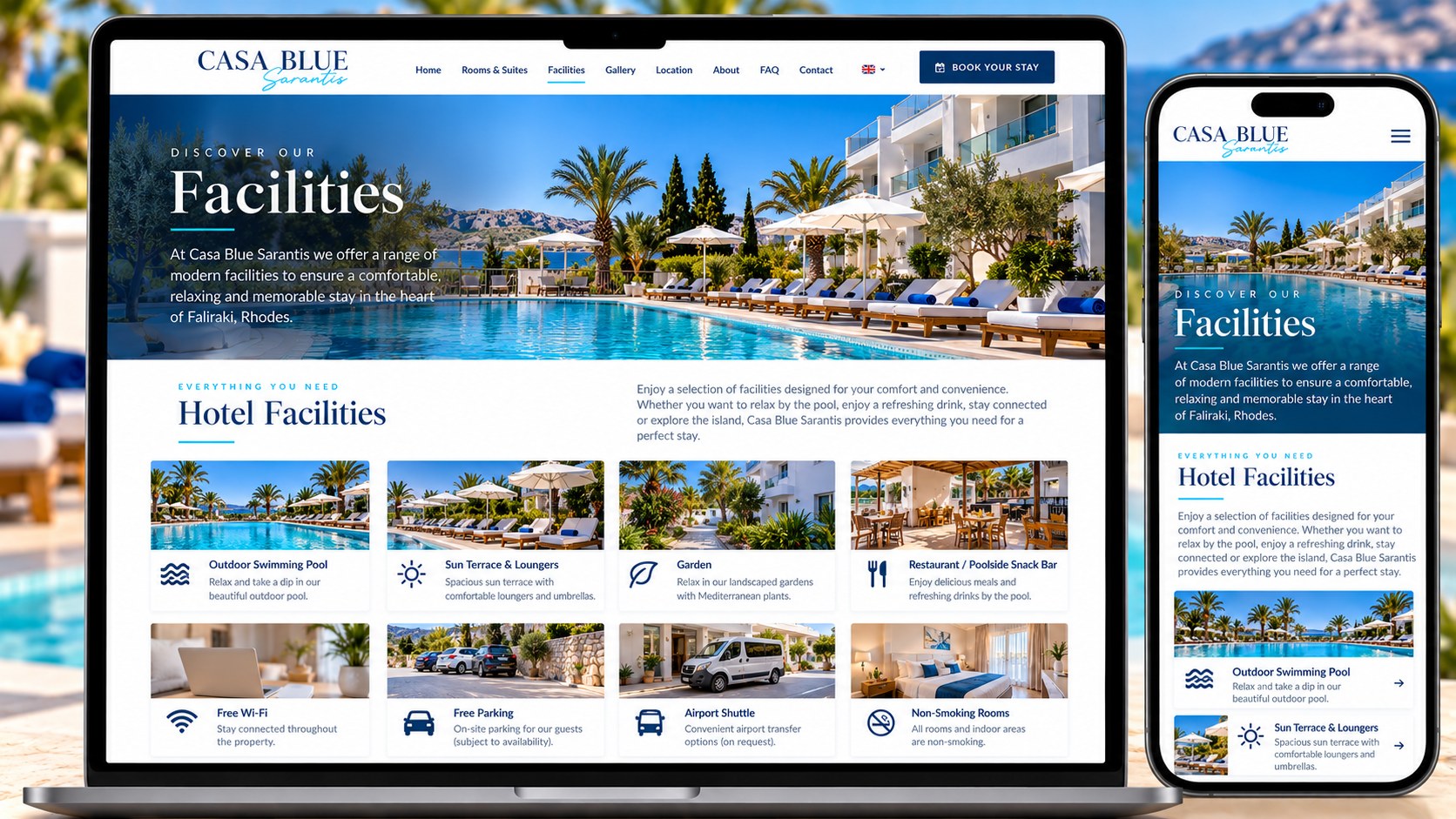
Facility cards turn a long amenities list into an easy-to-scan interface. Each item pairs relevant imagery with a short heading, icon and supporting description. Consistent spacing and card behaviour make the section feel like part of the same design system as the homepage and accommodation pages. Before launch, every amenity and operational detail should be checked against the property’s confirmed information.
Gallery UX: Letting Property Photography Lead
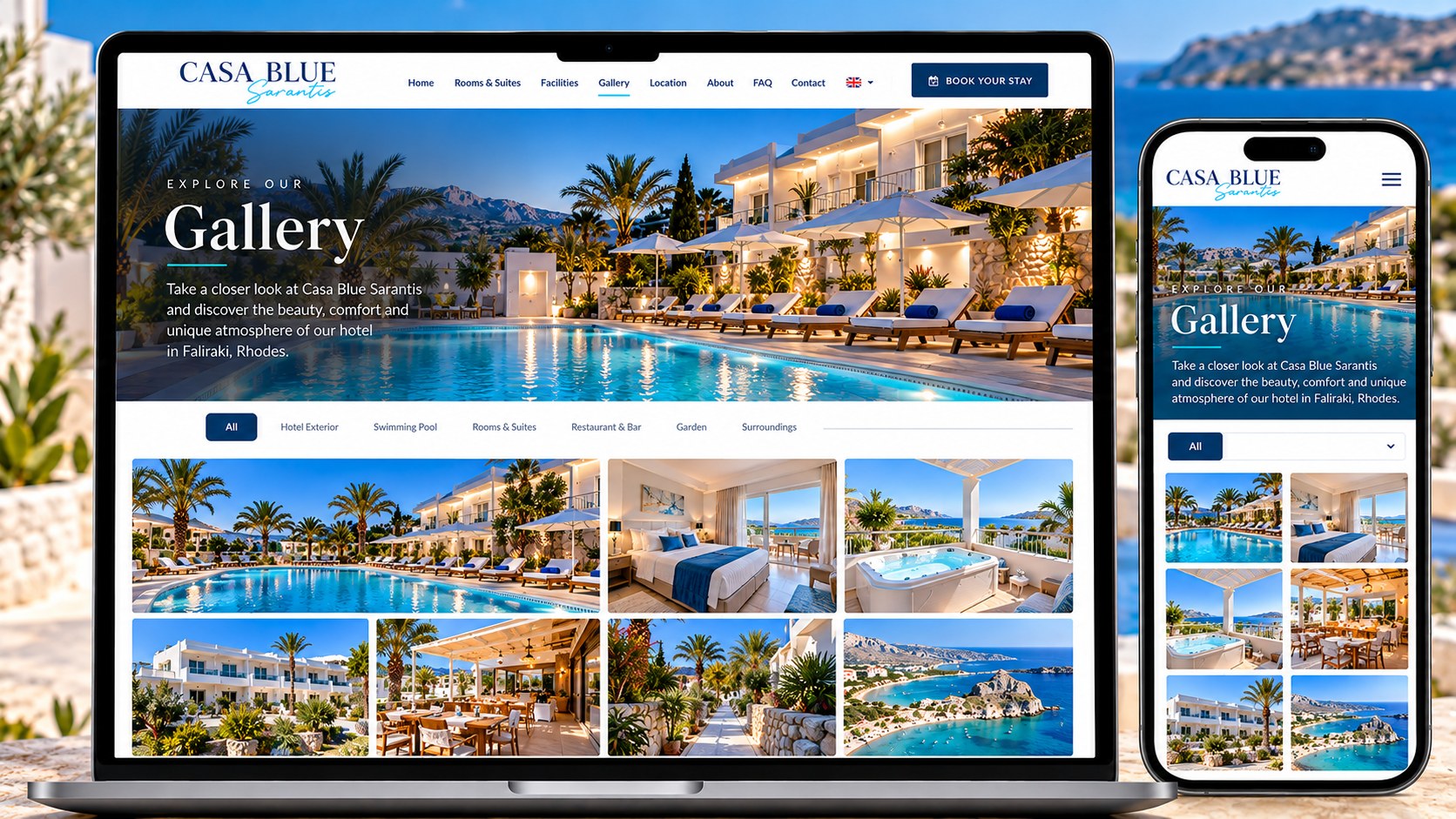
Hotel photography helps guests form expectations before they arrive. A category-led gallery can organise views of the property, pool, rooms, dining areas, gardens and surroundings without making visitors search through a single undifferentiated wall of images. Responsive image sizes, descriptive alternative text, sensible loading behaviour and stable image dimensions are essential parts of the implementation—not optional finishing touches.
Location Page: Connecting the Hotel to Rhodes
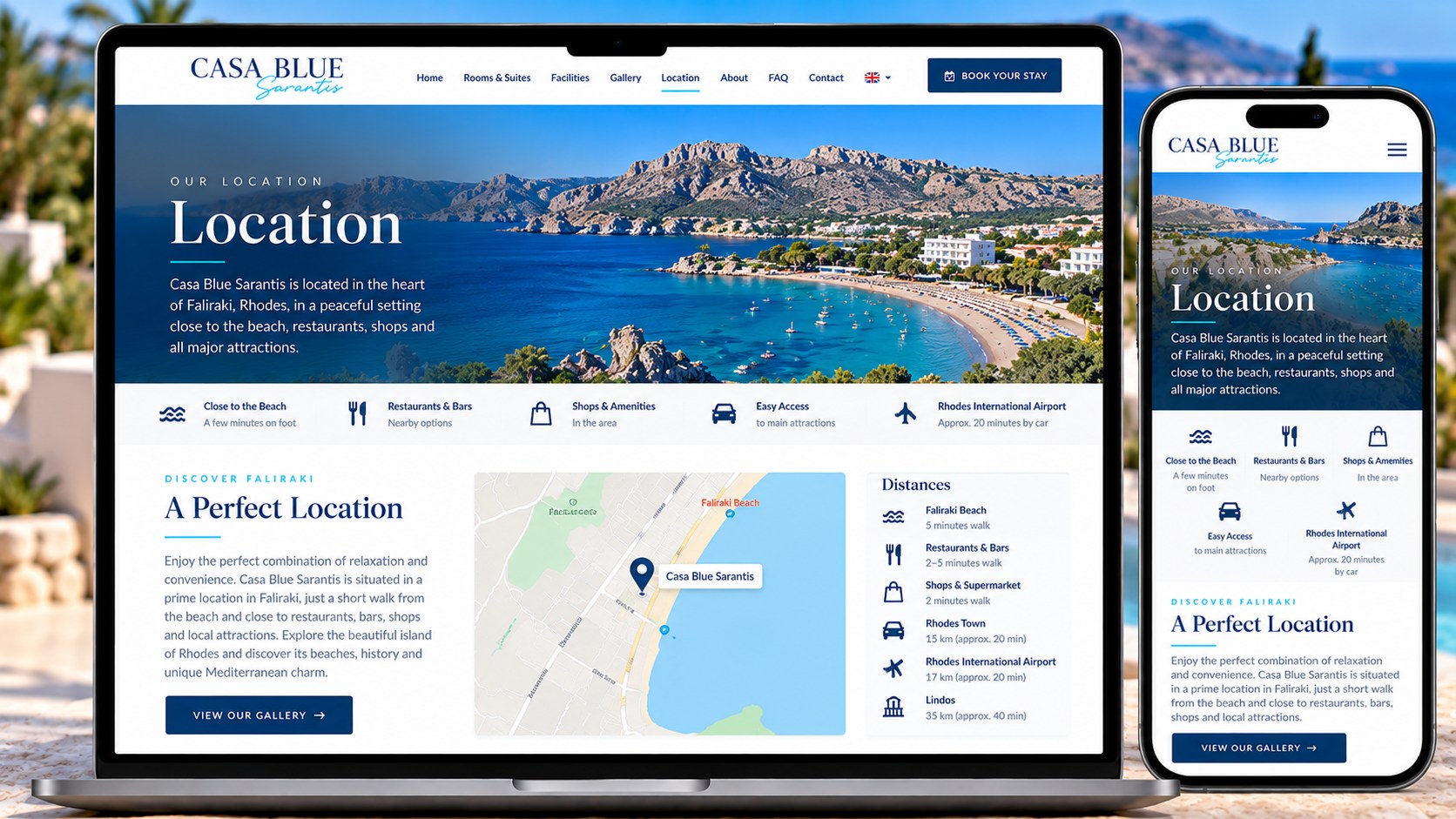
A useful location page connects the property with the places and experiences guests care about. The concept pairs a coastal hero with destination highlights, a map area and practical travel information. Distances, journey times, transport details and map pins must be verified before publication. A designed map illustration should not be presented as live navigation unless it is connected to a real mapping service.
Destination SEO: Building a Useful Faliraki Guide
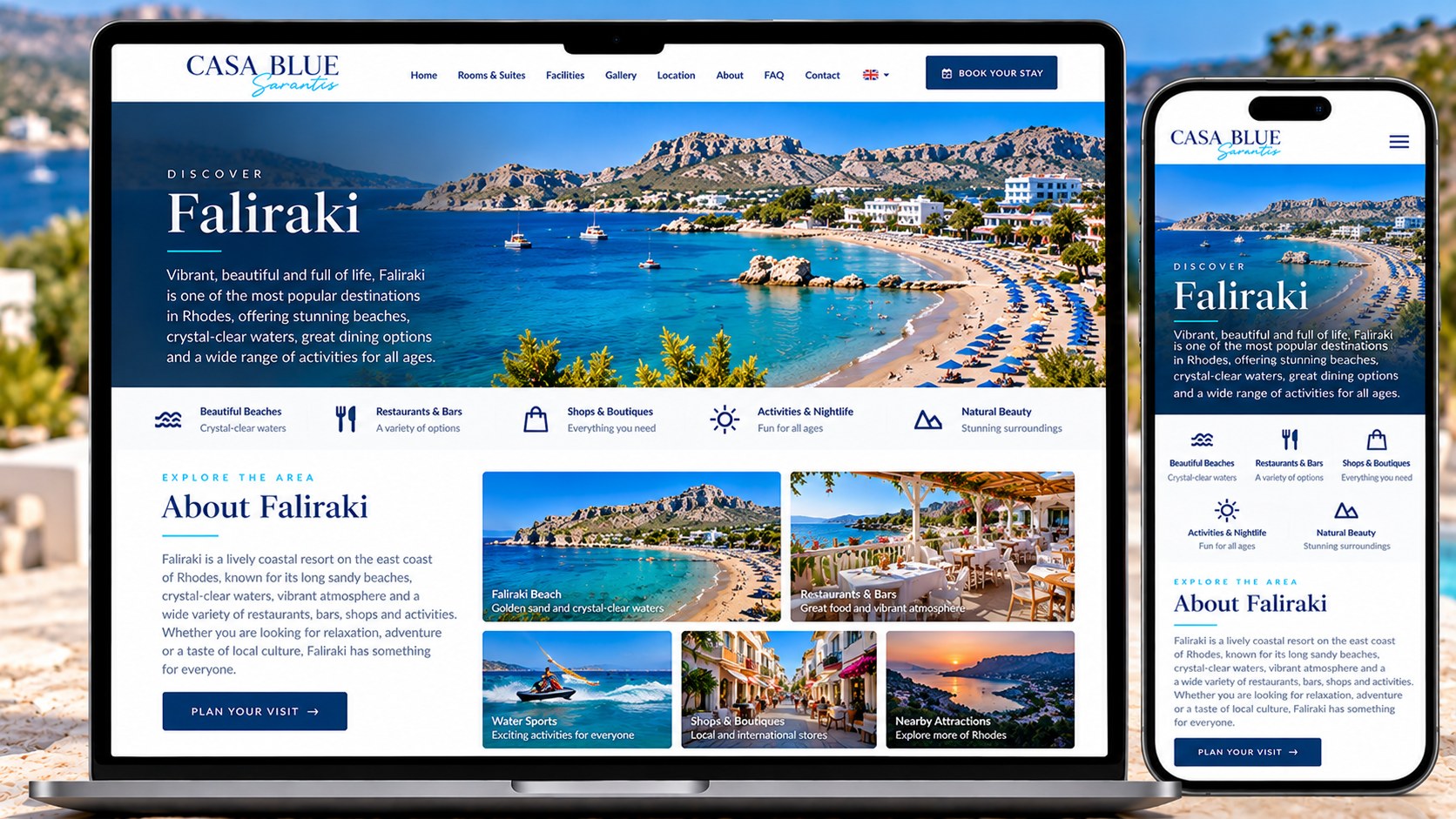
Destination content gives a hospitality website a useful role beyond listing rooms. A Faliraki guide can introduce beaches, dining, shopping, activities and nearby attractions, then link naturally to relevant accommodation and facilities pages. The strongest destination pages answer genuine visitor questions with original, accurate information instead of repeating place names to chase keywords.
About Page: Communicating the Property’s Identity
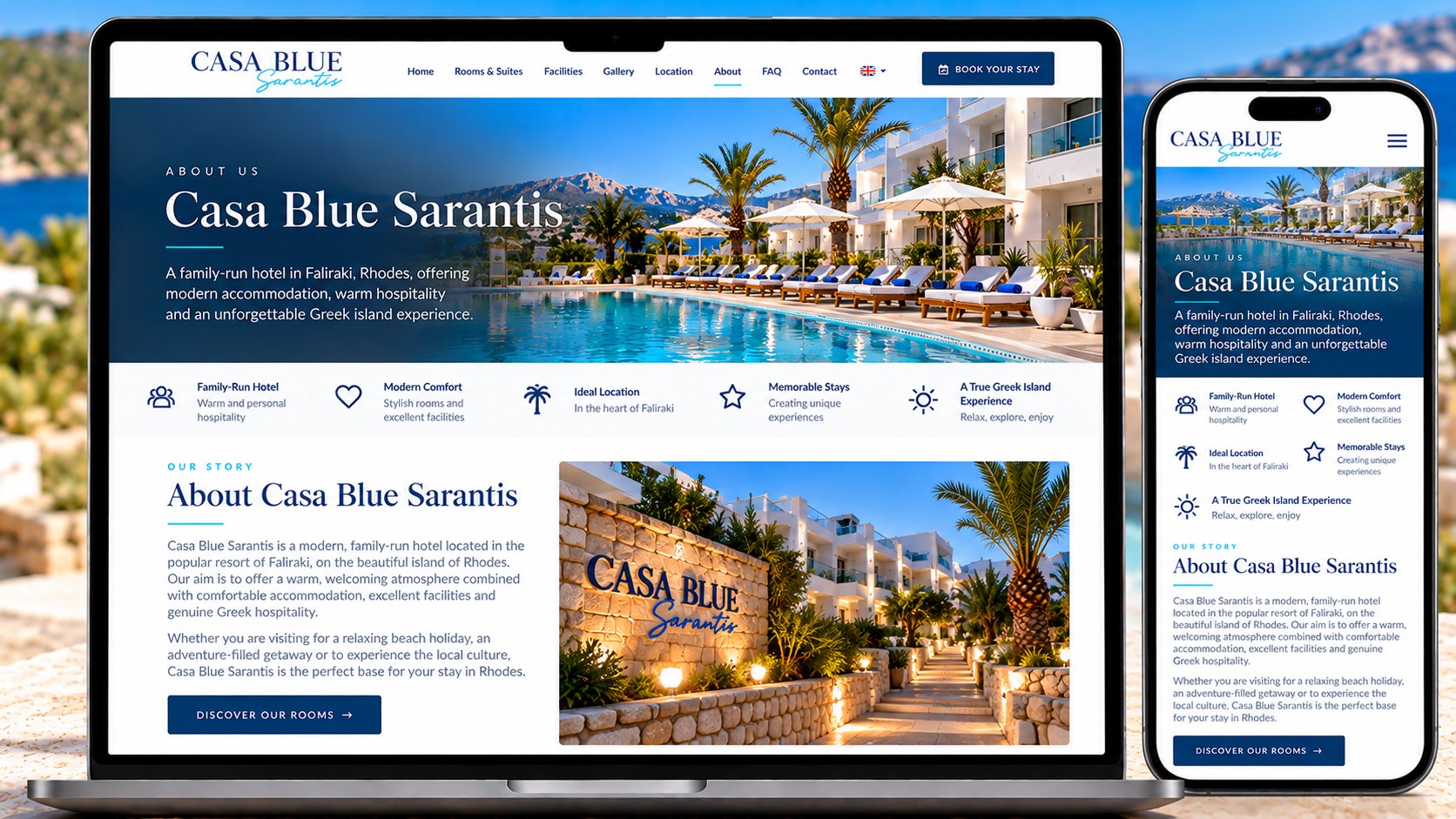
The About page should explain what makes the property distinctive in a credible, human way. The concept combines resort imagery with a clear heading, concise story and route to accommodation. Claims about ownership, service, history or guest experience should come from verified business information. Consistent typography, image treatment and calls to action help the page reinforce the wider brand rather than feel disconnected from it.
FAQ Design: Reducing Questions Before Booking
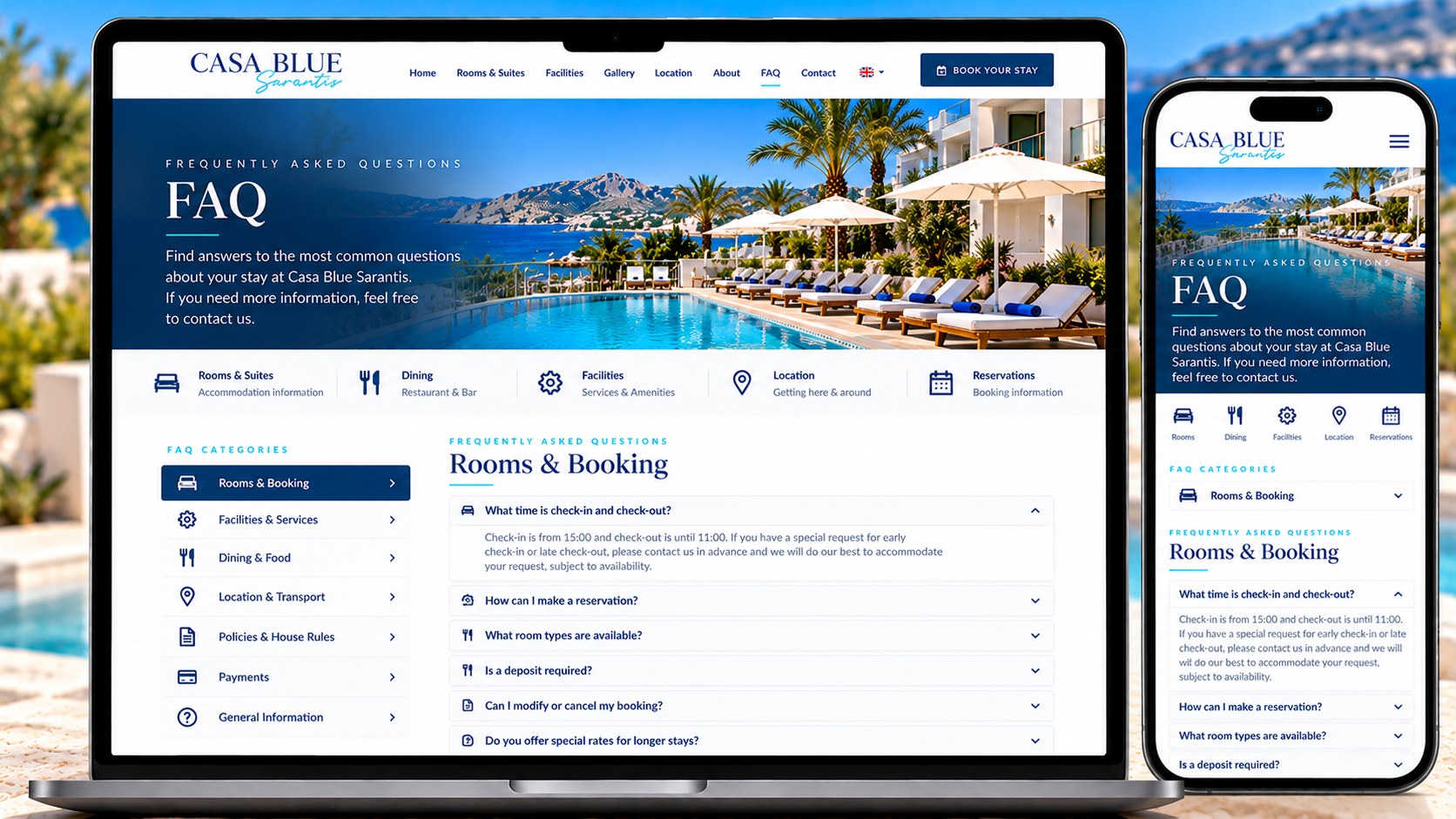
A structured FAQ helps visitors find practical information without navigating through multiple pages. Categories and expandable questions keep the interface organised on desktop and mobile. Answers about check-in, cancellation, payments, facilities and reservations must reflect the property’s actual policies. The content should be maintained as structured information so it remains consistent when the business updates its operations.
Contact Page: Clear Details and Reliable Forms
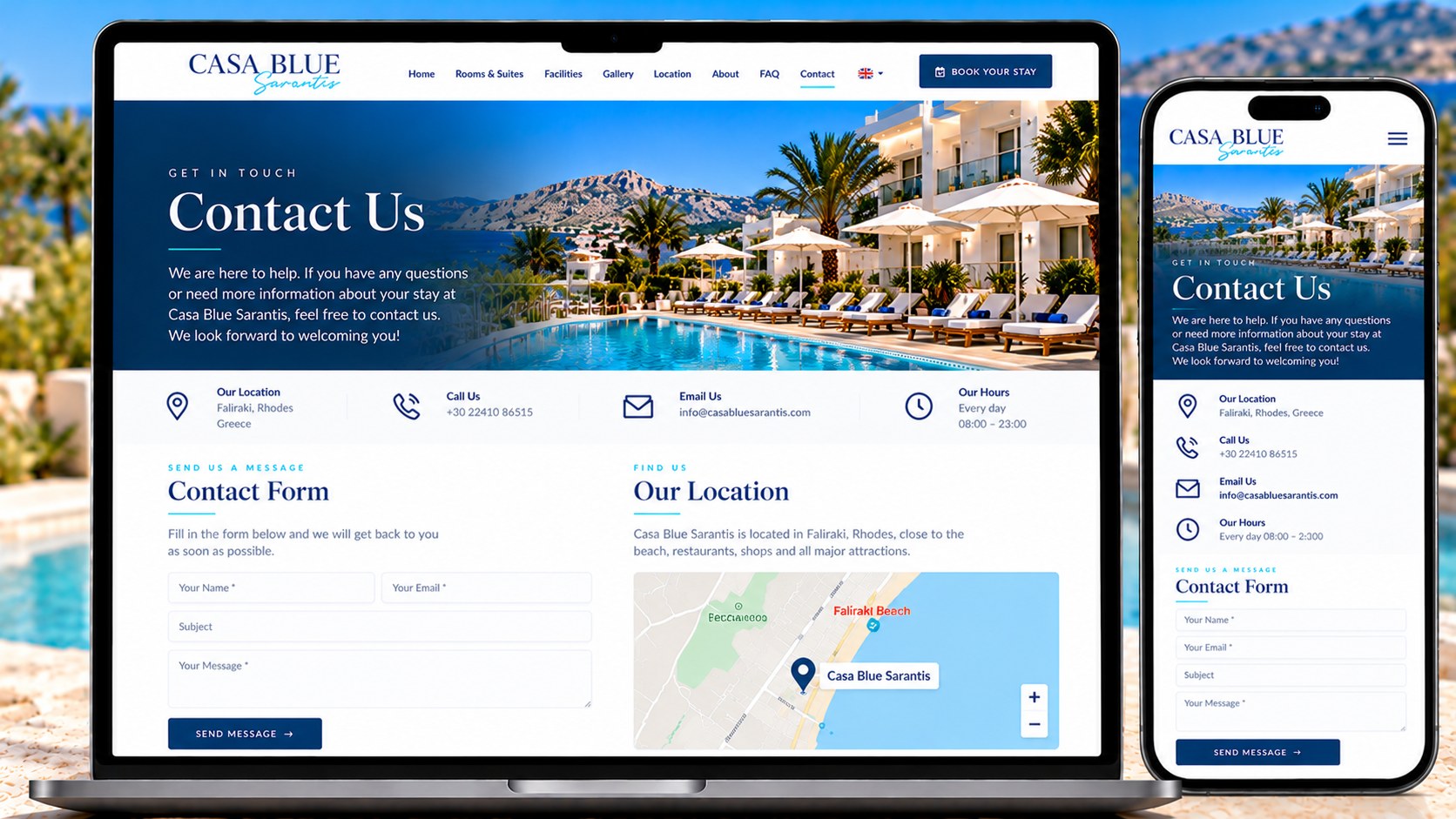
A contact page should make it easy to reach the business. Contact information, a message form and location details create a straightforward path for questions. A production form needs clear labels, validation, spam safeguards and reliable email delivery. Verify every address, phone number, email and opening hour before publishing; illustrative values in a design mockup are not a source of truth.
WordPress Architecture: Reusable Components, Structured Content
The supplied theme audit describes a modular classic PHP theme with Elementor Free integration and 22 custom widgets. Dedicated content types cover accommodation, facilities, destinations and FAQs, helping separate content from its presentation. Reusable components support consistent layouts and reduce the need to rebuild each section independently. The aim is a system that can be maintained and extended, not a one-off visual reproduction.
Technical SEO: A System Rather Than a Checkbox
The audit documents native metadata, Open Graph output, JSON-LD structured data, breadcrumbs, sitemap and robots handling, destination SEO workflows and a Google Search Console Command Center. These capabilities provide a foundation for a disciplined SEO workflow; they do not guarantee rankings. Page titles, useful original copy, internal links, image alt text, valid structured data and ongoing indexation checks still need human review.
Multilingual SEO and Content Operations
The audit lists English, German, French, Italian, Polish, Dutch and Greek as configured languages. Its production policy is to use language-specific SEO URLs and keep the separate Simple Translation system disabled. Translation work also requires checking page relationships, links, images and galleries after synchronisation. A language switcher alone is not proof that every translated page is complete.
Performance, Security and Production Quality
The audit records modules for asset loading, image handling, caching, Core Web Vitals-related work, security hardening and contact-form safeguards. These are implementation foundations, not measured performance scores or guarantees of security. A responsible release process should test real devices, form delivery, image loading, backups, HTTPS, schema, content accuracy and the sitemap. Demo imagery and any unresolved confirmation placeholders should be removed before launch.
From Design Mockups to a Production-Ready Website
- Define typography, colours, spacing, buttons and responsive rules.
- Build shared components for headers, footers, hero sections, cards and calls to action.
- Manage rooms, facilities, destinations and FAQs as structured content.
- Test layouts on desktop, tablet and mobile.
- Connect booking actions to the real reservation flow.
- Validate SEO metadata, schema, multilingual URLs, hreflang and sitemap output.
- Run production QA for accessibility, performance, forms, security and content accuracy.
Design, Systems and Excellence
The strongest website experience comes from aligning visual design, content structure, functionality and technical quality. The homepage creates the first impression, but room details, facilities, destination information, FAQs and contact flows all contribute to the guest journey. Reusable components, structured content, multilingual management, SEO tooling and operational checks make the system easier to maintain over time. The developer’s task is not only to reproduce a visual reference, but to turn it into a coherent and dependable digital experience.
Editorial note: This case study is based on the supplied Casa Blue Sarantis theme audit dated 17 October 2026 and the visual design concepts created for this article. The audit maps theme architecture and documented features; it does not include live-site content QA, runtime performance measurements or a line-by-line penetration test.